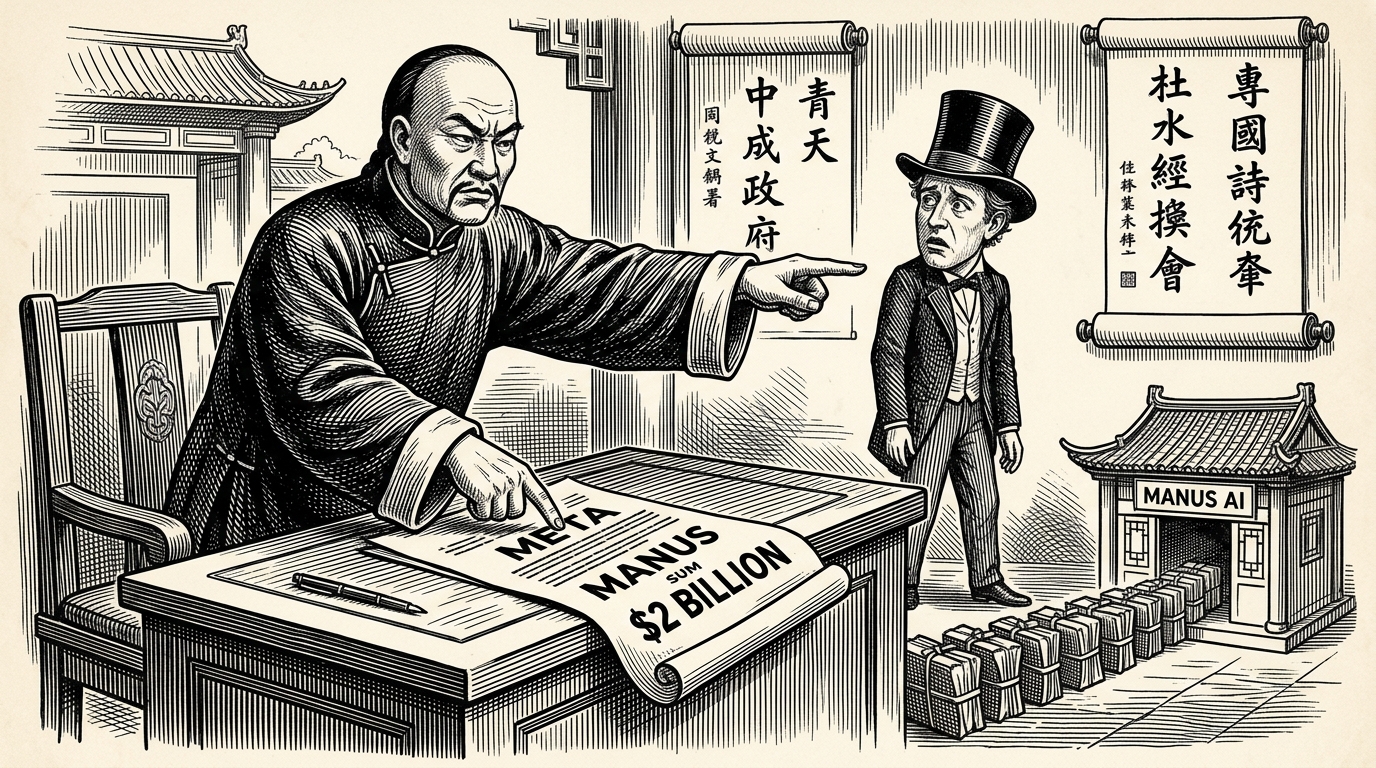
Chinese regulators have ordered Meta to reverse its approximately $2 billion acquisition of Manus, a Chinese artificial intelligence start-up, in a ruling that could have significant implications for future partnerships between Chinese tech founders and foreign companies.
Chinese authorities have blocked Meta's acquisition of Manus, an AI start-up, directing the American social media giant to unwind the approximately $2 billion deal after regulators determined it may have violated Beijing's investment rules, according to reporting by the New York Times and the Financial Times.
The decision marks a significant intervention by Beijing into a high-profile cross-border technology transaction and underscores the increasingly complex regulatory environment facing foreign companies seeking to acquire Chinese-founded AI ventures.
Manus, which attracted significant international attention earlier in 2025 for its autonomous AI agent capabilities, became one of the most closely watched AI start-ups to emerge from China. Its apparent deal with Meta had been seen as a landmark moment — a sign that Chinese AI talent and technology could command top-tier valuations from Western technology giants.
China's regulators reviewed whether the acquisition violated the country's foreign investment rules, the Financial Times reported. The precise legal grounds for the ruling had not been fully detailed at the time of publication, and the full impact of the decision remained unclear.
The New York Times noted that the ruling could send a chilling signal to Chinese technology founders who may be considering partnerships or acquisition deals with foreign companies. Such founders may now face greater uncertainty about whether Beijing will permit them to exit via foreign buyers — one of the most lucrative paths available to start-up entrepreneurs.
Meta has not made a detailed public statement on the ruling, and representatives for Manus were not immediately available for comment.
The decision arrives against a backdrop of heightened geopolitical tension between the United States and China, particularly in the technology sector. Both governments have moved aggressively in recent years to restrict the cross-border flow of sensitive technologies, including artificial intelligence. Washington has imposed sweeping export controls on advanced semiconductors destined for China, while Beijing has tightened its own rules governing data security and foreign investment in strategic industries.
Analysts noted that the ruling reflects Beijing's dual concern: protecting strategically valuable AI assets from foreign ownership while also avoiding the appearance of facilitating the transfer of Chinese-developed technology — and Chinese talent — to American competitors.
Analysis
Why This Matters
- Chinese founders and investors in AI start-ups now face heightened uncertainty about whether foreign acquisitions will be permitted, potentially limiting their exit options and chilling deal-making activity.
- The ruling signals that Beijing views advanced AI capabilities as strategically sensitive assets, not merely commercial products subject to normal market transactions.
- The decision could prompt retaliatory scrutiny of Chinese investments in the United States, further deepening the bifurcation of global technology markets.
Background
Tensions between the US and China over technology have escalated significantly since 2018, when Washington began restricting Chinese companies' access to advanced American semiconductor technology. The Biden administration tightened those controls further, and the Trump administration has continued along the same trajectory. China has responded with its own set of restrictions, including export controls on rare earth materials and tighter oversight of foreign investment in domestic technology sectors.
Manus emerged in early 2025 as one of China's most buzzed-about AI start-ups, showcasing autonomous agent capabilities that drew comparisons to leading Western AI systems. Its rapid rise made it a symbol of China's growing competitiveness in frontier AI development, which also made it a politically sensitive asset in the eyes of Beijing's regulators.
China has for several years maintained a foreign investment review framework that allows authorities to block or unwind transactions deemed to pose risks to national security or economic interests. The application of those rules to a Chinese start-up being acquired by a foreign buyer, rather than the reverse, represents a notable and arguably novel use of that regulatory power.
Key Perspectives
Beijing regulators: Authorities appear determined to prevent the transfer of strategically valuable AI assets and talent to foreign — particularly American — companies, framing the intervention as consistent with national security and investment review frameworks.
Meta: The company had positioned the Manus acquisition as a means of accelerating its AI capabilities. The forced divestiture represents both a financial setback and a strategic blow, limiting its ability to acquire cutting-edge AI talent and technology from China.
Chinese tech founders and investors: The ruling introduces a significant new risk for entrepreneurs who may have assumed that building a world-class AI company could lead to a lucrative foreign acquisition. The chilling effect on future deal-making could reshape how Chinese AI ventures approach fundraising, partnerships, and long-term strategy.
Critics/Skeptics: Some analysts warn that blocking foreign acquisitions of domestic start-ups may ultimately harm China's own innovation ecosystem by reducing the incentives for entrepreneurship and limiting the capital available to founders. Others question whether the ruling will be consistently enforced or applied selectively as a geopolitical lever.
What to Watch
- Whether Meta challenges the ruling through legal or diplomatic channels, and how Beijing responds to any such efforts.
- The reaction from other Chinese AI start-ups with foreign investment or acquisition discussions underway — any withdrawal of foreign interest would signal the ruling's broader chilling effect.
- Future Chinese regulatory decisions on cross-border AI transactions, which will clarify whether this case establishes a precedent or represents a one-off intervention.