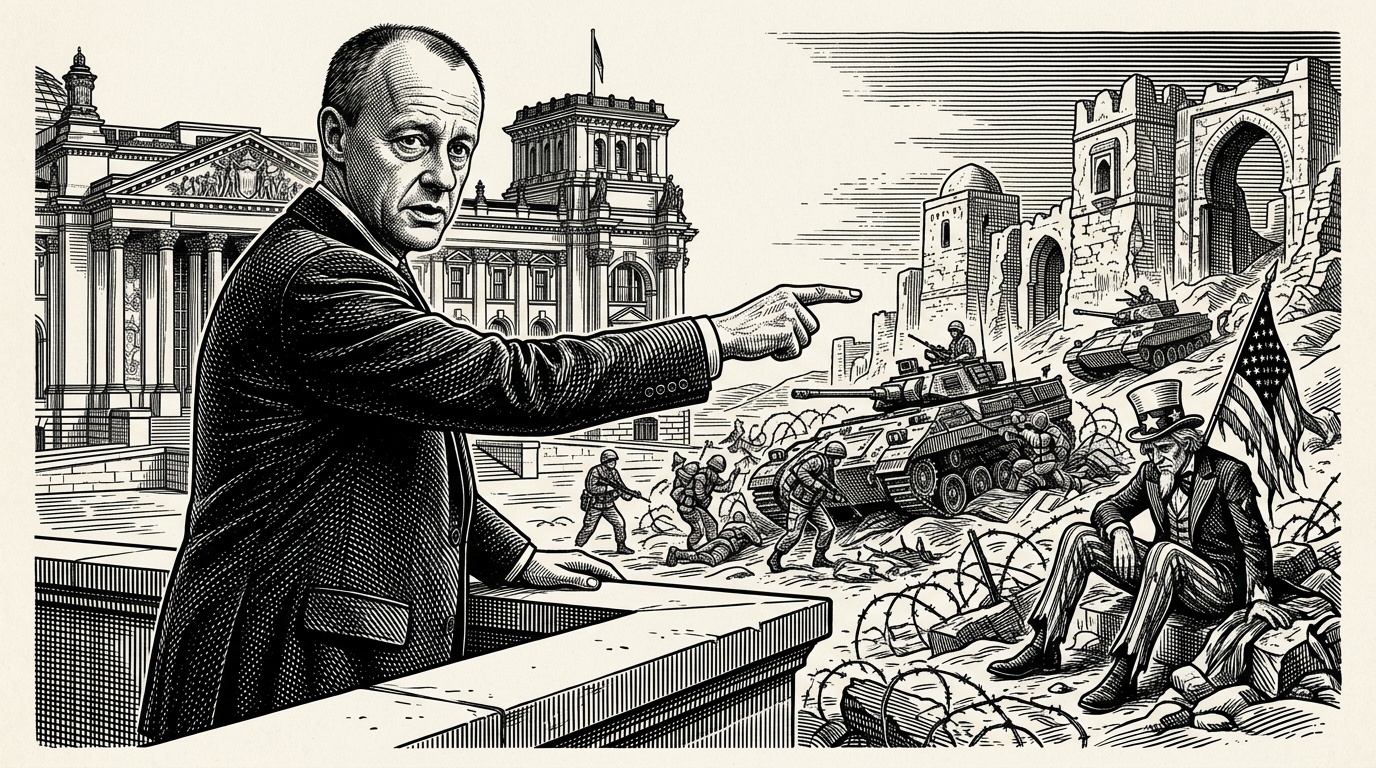
German Chancellor Friedrich Merz issued a stark warning on Sunday that Iran had 'humiliated' the United States in its recent conflict, cautioning that Washington risks becoming mired in a prolonged military engagement similar to the costly wars in Iraq and Afghanistan.
German Chancellor Friedrich Merz delivered a blunt assessment of the US-Iran conflict on Sunday, declaring that Iran had emerged 'clearly stronger' from its confrontation with the United States and warning that America faces the prospect of another grinding military quagmire.
Merz, speaking publicly on the matter, did not mince words in his characterisation of the outcome, describing Iran as having 'humiliated' the United States — language that represents a significant diplomatic statement from the leader of one of Washington's closest European allies.
Drawing Historical Parallels
The German chancellor explicitly invoked the spectre of Iraq and Afghanistan — two conflicts that defined a generation of US foreign policy and resulted in significant American military casualties, enormous financial costs, and ultimately inconclusive outcomes — as cautionary examples of what deeper involvement in the region could produce.
The comparison carries particular weight given Germany's own experience as a partner in the NATO-led mission in Afghanistan, where German forces served for nearly two decades before the country's withdrawal.
A Warning From an Ally
Merz's comments are notable precisely because they come from a close US ally rather than a geopolitical rival. Germany, as a core member of NATO and the European Union, generally maintains careful diplomatic language when addressing American military conduct. The directness of his remarks signals growing concern within European capitals about the trajectory of US engagement in the Middle East.
The German chancellor's warning also reflects broader European anxieties about regional destabilisation and the potential for a wider conflict that could affect energy supplies, refugee flows, and global economic stability — concerns that weigh heavily on European governments regardless of political orientation.
Limited Source Detail
The full context of Merz's remarks — including the specific forum in which they were delivered, the precise nature of the conflict he was referencing, and any response from Washington or Tehran — was not available in the source material at time of publication. Zotpaper will update this article as further details emerge.
The remarks nonetheless underscore a widening transatlantic divergence in how the United States and its European partners assess the outcomes and risks of military confrontation with Iran.
Analysis
Why This Matters
- A senior leader of a key US ally publicly declaring that Iran 'humiliated' America represents an unusual and significant diplomatic signal that could affect NATO cohesion and transatlantic relations.
- If European allies are openly questioning US military effectiveness and strategy in the Middle East, it may complicate Washington's ability to build coalitions for any future action in the region.
- The Iraq and Afghanistan comparison is politically charged — it invokes domestic US debates about military overreach and the human and financial costs of prolonged conflicts.
Background
US-Iran tensions have been a defining feature of Middle Eastern geopolitics since the 1979 Islamic Revolution, when Iran severed diplomatic ties with Washington. The relationship has oscillated between periods of negotiation — most notably the 2015 nuclear deal (JCPOA) — and acute confrontation, including the 2020 US killing of Iranian General Qasem Soleimani.
Germany has historically played a mediating role in nuclear diplomacy with Iran, participating in the E3 format alongside France and the United Kingdom. This background gives Merz's comments additional weight, as Berlin has sought to maintain channels of communication with Tehran even during periods of high tension.
The Iraq and Afghanistan wars remain deeply formative references in Western strategic thinking. The US-led invasion of Iraq in 2003, initially backed by some European states but opposed by Germany and France, and the subsequent 20-year Afghanistan mission both ended without the decisive outcomes their architects envisioned, leaving lasting scars on Western military and political institutions.
Key Perspectives
Chancellor Merz / Germany: Berlin appears to view the conflict as a strategic setback for the United States, and is warning against escalation that could produce another prolonged, costly, and inconclusive military engagement — with potential spillover effects on European security and economy.
United States: Washington's position on the conflict's outcome has not been detailed in available source material. US administrations typically contest characterisations of military engagements as defeats or humiliations, and are likely to push back on Merz's framing through diplomatic channels.
Critics/Skeptics: Some analysts may argue that Merz's public comments, however well-intentioned, risk emboldening Iran and undermining US deterrence at a sensitive moment. Others may question whether the 'humiliation' framing oversimplifies a complex and still-evolving situation.
What to Watch
- Official US government response to Merz's remarks, particularly from the State Department or White House, which will indicate how seriously Washington takes allied criticism.
- Whether other European leaders echo or distance themselves from Merz's assessment, signalling broader European consensus or division.
- Any escalation or de-escalation in US-Iran relations in the coming weeks that could either validate or undercut Merz's warning.