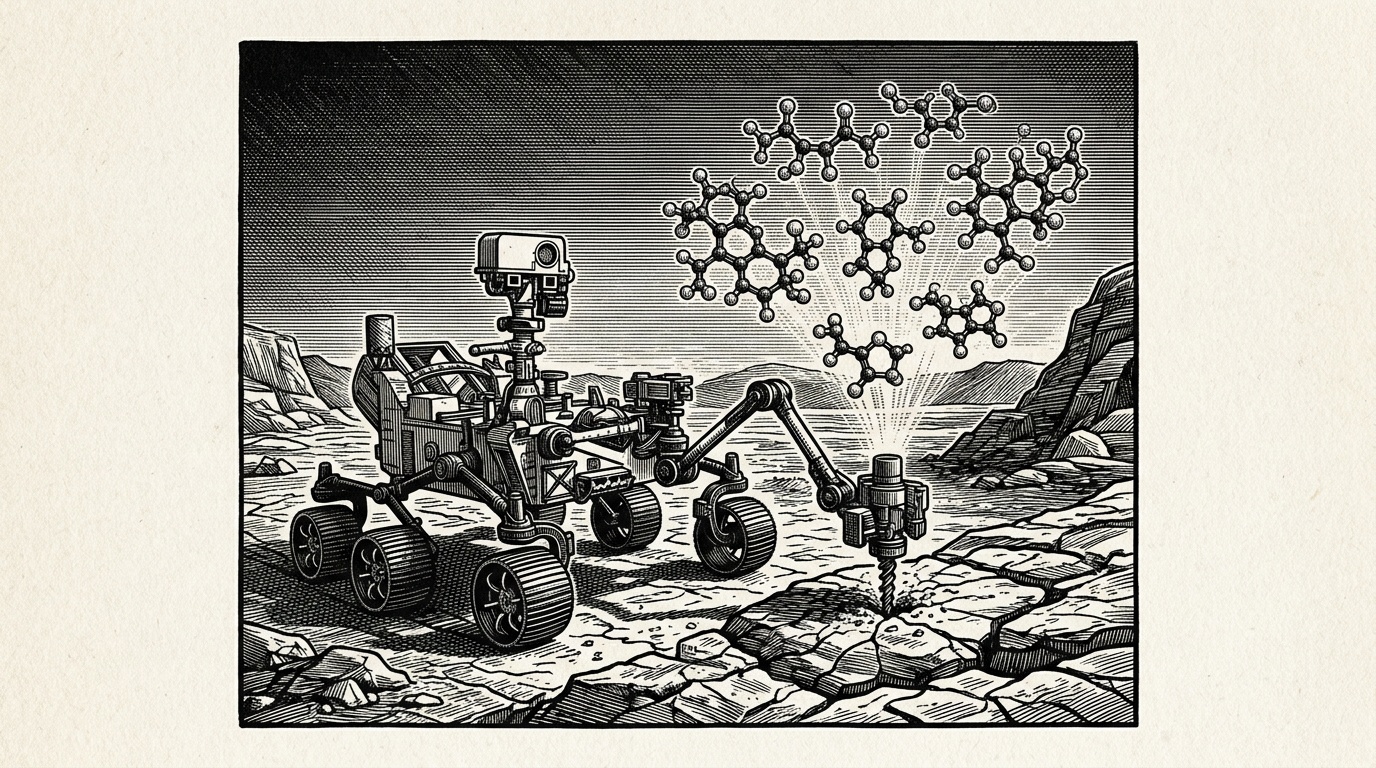
NASA's Curiosity rover has detected seven organic molecules in a dried Martian lakebed near the equator, including chemicals considered fundamental building blocks for the origin of life on Earth, scientists announced Monday — though researchers caution the discovery does not confirm that life ever existed on Mars.
NASA's Curiosity rover has made one of its most significant findings since landing on Mars in 2012, identifying a suite of organic molecules in an ancient dried lakebed that scientists believe may have been preserved for approximately 3.5 billion years.
Five of the seven compounds detected had never previously been observed on Mars. While organic molecules — carbon-containing compounds — are not themselves evidence of life, many are considered chemical prerequisites for life as we know it. On Earth, such molecules form the structural basis of amino acids, lipids, and other biological materials.
"Is it life? We can't tell," one scientist involved in the research noted, capturing the careful uncertainty that pervades the findings. The analysis, conducted by instruments aboard the robotic rover, cannot determine whether the compounds originated from ancient microbial life, were delivered to Mars via meteorite impacts, or arose through purely geological and chemical processes.
The discovery was made at a site in a dried lakebed near the Martian equator — an area long considered a promising location to search for signs of ancient habitability. Scientists believe Mars harboured liquid water on its surface billions of years ago, and such lakebeds represent environments where life, had it emerged, might have left behind chemical traces.
Researchers say the findings carry a hopeful implication: if microbial life once existed on Mars, the planet's geology appears capable of preserving organic chemical fingerprints over geological timescales. That makes the case for continued and more sophisticated exploration more compelling.
The detection builds on years of incremental discoveries by Curiosity, which has previously identified simpler organic compounds and seasonal methane variations in the Martian atmosphere. This latest finding represents a more complex chemical signature, raising new questions about the planet's ancient chemistry and the potential for past life.
NASA's Perseverance rover, currently operating in the Jezero Crater, is collecting rock samples intended for eventual return to Earth, where more powerful laboratory analysis could shed further light on questions that rover-based instruments alone cannot fully resolve.
Analysis
Why This Matters
- The discovery strengthens the scientific case that Mars once had the chemical conditions necessary for life, adding urgency to ongoing and planned missions to the planet.
- If organic molecules can survive for 3.5 billion years in Martian rock, it suggests sample-return missions could yield meaningful biological data — with profound implications for our understanding of life in the universe.
- The findings will inform where future rovers and landers target their searches, potentially reshaping NASA and ESA mission planning for the coming decade.
Background
Curiosity landed in Gale Crater in August 2012 as part of NASA's Mars Science Laboratory mission, specifically designed to assess whether Mars ever had conditions suitable for microbial life. Over more than a decade of operations, it has confirmed that ancient Mars had liquid water, a thicker atmosphere, and the basic chemical ingredients associated with habitability.
Previous detections of organic molecules on Mars — including thiophenes, benzene, and toluene announced in 2018 — established that organics could survive on the planet's surface despite its harsh radiation environment. The presence of perchlorates in Martian soil had long complicated the detection of organics, making each confirmed finding a technical as well as scientific achievement.
The search for life beyond Earth has intensified in recent years, with the discovery of potentially habitable exoplanets and growing evidence of complex chemistry throughout the solar system — including organic molecules on comets, asteroids, and the moons of Saturn and Jupiter.
Key Perspectives
NASA Scientists: Regard the discovery as a significant step forward, emphasising that Mars appears capable of preserving complex organic chemistry over billions of years — a prerequisite for any future confirmation of ancient life.
Astrobiologists: Cautiously optimistic; note that while these molecules are consistent with biological processes, they are also consistent with non-biological chemistry. The findings justify expanded investigation rather than firm conclusions.
Critics/Skeptics: Urge restraint in interpretation, pointing out that organic molecules are routinely produced by geological and meteoritic processes with no biological involvement. Without isotopic analysis or structural markers specific to biology, the source remains genuinely ambiguous.
What to Watch
- Progress on NASA's Mars Sample Return mission, which aims to bring Perseverance's collected samples to Earth for laboratory analysis capable of resolving questions Curiosity's instruments cannot.
- Whether the specific molecular structures identified can be matched to known biological or abiotic chemical pathways, which could narrow the range of possible origins.
- Any follow-up drilling or sampling by Curiosity at adjacent sites in the same lakebed, which could establish whether the organic compounds are widespread or localised.