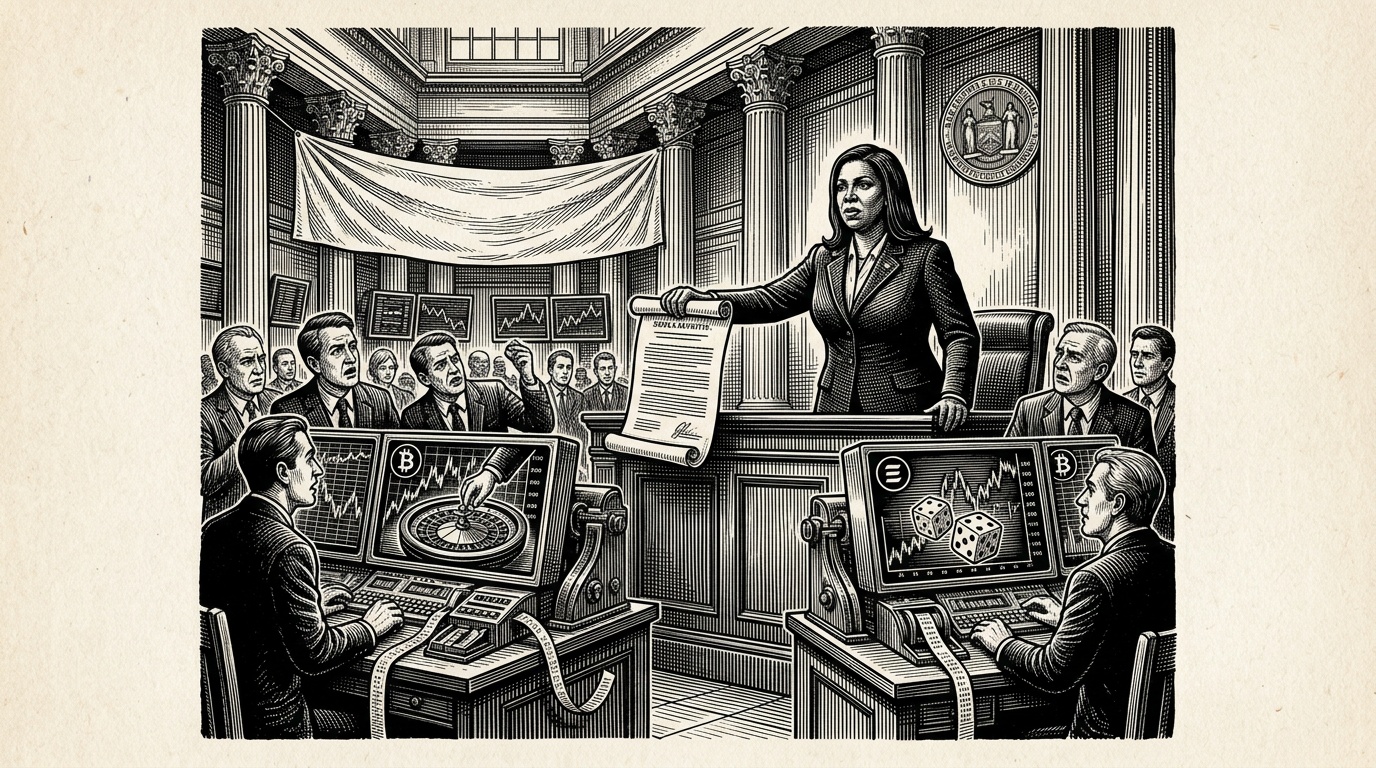
New York Attorney General Letitia James filed lawsuits against cryptocurrency exchanges Coinbase and Gemini on Monday, alleging the companies illegally offer gambling services through their prediction market platforms and seeking billions of dollars in damages.
New York Attorney General Letitia James has taken aim at two of the United States' largest cryptocurrency exchanges, filing lawsuits against Coinbase and Gemini over their prediction market offerings, which she characterises as unlicensed gambling operations.
"Gemini and Coinbase's so-called prediction markets are just illegal gambling operations," James said in a statement accompanying the legal action. The suits seek billions of dollars in damages from both companies.
Prediction markets allow users to buy and sell contracts tied to the outcome of future events — ranging from election results and sporting contests to economic indicators and geopolitical developments. Proponents argue these platforms generate valuable information by aggregating the collective judgement of participants, while critics contend they are functionally indistinguishable from sports betting or other forms of wagering.
Coinbase and Gemini are among the most prominent names in the American cryptocurrency industry. Coinbase is publicly listed on Nasdaq and has positioned itself as a regulatory-compliant platform; Gemini, founded by Tyler and Cameron Winklevoss, has similarly courted institutional credibility. Both companies have expanded their product offerings in recent years, with prediction markets representing one of the more contentious additions.
The legal action arrives at a complex moment for crypto regulation in the United States. The industry has broadly welcomed what it perceives as a more permissive federal posture under the current administration, including signals from the Commodity Futures Trading Commission (CFTC), which has historically held jurisdiction over certain prediction market products. State-level actions, however, remain an independent avenue for enforcement, and New York's Martin Act — one of the most powerful state securities laws in the country — gives the AG's office broad authority to pursue financial fraud claims.
Neither Coinbase nor Gemini had issued public responses to the lawsuits at the time of publication. The companies are expected to contest the characterisation of their platforms as gambling operations, likely arguing that prediction markets constitute legitimate financial instruments already subject to federal oversight.
The outcome of these cases could have significant implications for the broader prediction market industry, which has seen renewed interest and investment following the prominent role such platforms played during recent election cycles.
Analysis
Why This Matters
- The lawsuits could set a legal precedent determining whether prediction markets are classified as gambling under state law — a distinction with enormous consequences for an industry experiencing rapid growth.
- If New York succeeds, other states may pursue similar actions, potentially fracturing the regulatory landscape that crypto exchanges must navigate even as federal regulators adopt a lighter touch.
- Billions in potential damages represent an existential financial threat to the platforms involved, and a ruling against Coinbase or Gemini could prompt exchanges nationwide to suspend prediction market products.
Background
Prediction markets have existed in various forms for decades, with academic platforms like the Iowa Electronic Markets operating since the late 1980s. However, mainstream adoption was long constrained by regulatory uncertainty. The CFTC historically maintained that event contracts tied to certain outcomes — particularly political elections — were contrary to the public interest and therefore unlawful.
That posture began shifting in recent years. Kalshi, a regulated prediction market operator, won a landmark legal battle against the CFTC in 2024, paving the way for election-related contracts on regulated platforms. Coinbase and Gemini subsequently moved to offer similar products to their large existing user bases, bringing prediction markets to a far wider audience.
New York has long maintained some of the strictest financial regulation in the country. The state's Department of Financial Services issues its own "BitLicense" for crypto operators, and the AG's office has a track record of aggressive enforcement against crypto firms it considers non-compliant, having previously taken action against Tether, Bitfinex, and others.
Key Perspectives
New York Attorney General: James argues the platforms are gambling operations dressed up in financial language, and that New York residents deserve protection from unregulated wagering regardless of the technological wrapper around it.
Coinbase and Gemini: Both companies are expected to argue that their prediction market products are legitimate financial instruments operating within existing federal frameworks, and that state-level gambling laws do not apply to federally overseen markets.
Critics and legal scholars: Some observers caution that the line between a futures contract and a gambling wager is genuinely blurry, and that courts have historically struggled to draw it cleanly. Others note that the AG's broad use of the Martin Act has occasionally been challenged as overreach.
What to Watch
- Whether the CFTC or other federal regulators file amicus briefs or otherwise weigh in, which would signal how the federal government views state jurisdiction over prediction markets.
- Court rulings on any preliminary injunctions — James may seek to halt the platforms' operations while litigation proceeds, which would be an immediate and material impact on users.
- Responses from other major prediction market operators, such as Kalshi and Polymarket, which could face similar scrutiny if New York's legal theory prevails.