Twenty Arrested in Brisbane After Protesters Chant Phrase Banned Under Queensland Law

Demonstrators defy state government's prohibition on 'from the river to the sea' and 'globalise the intifada'

edit
By LineZotpaper
Published
Read Time2 min
Sources3 outlets
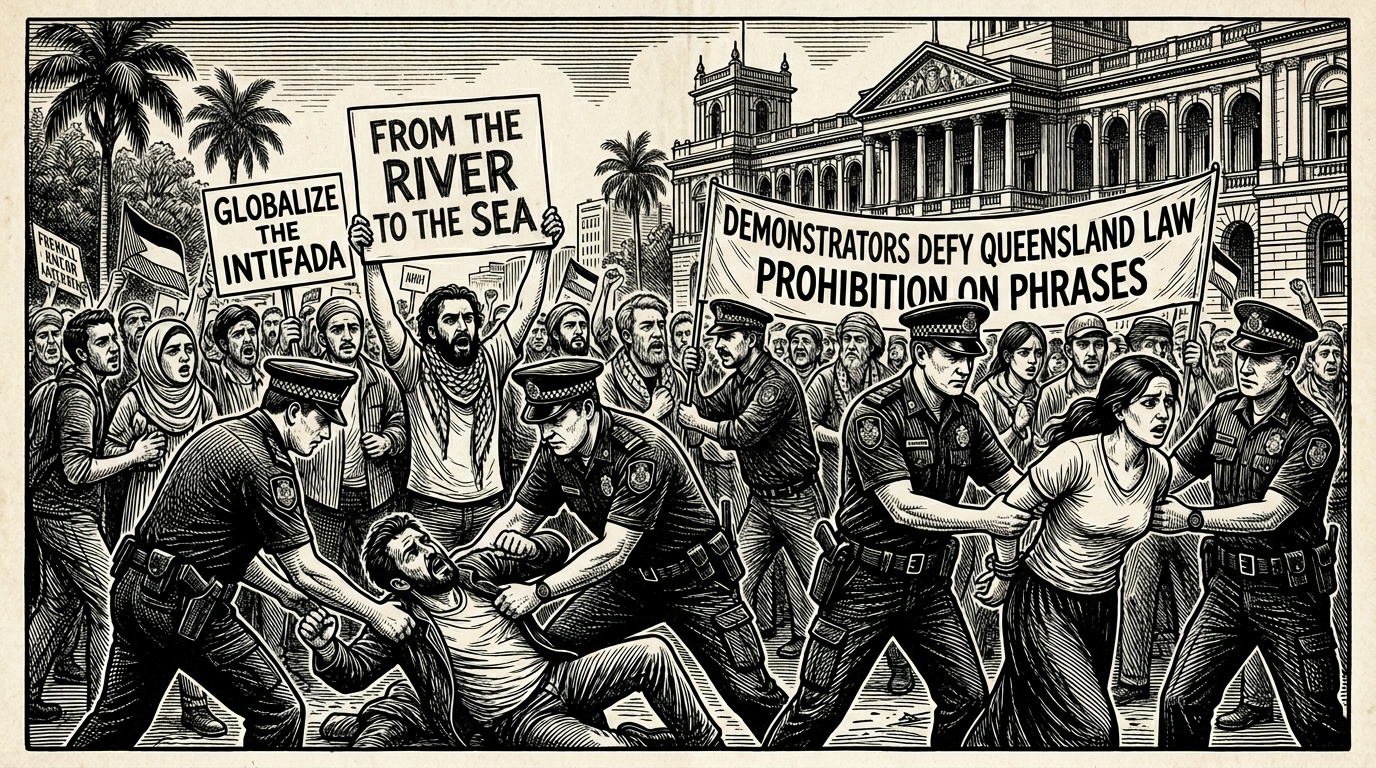
Queensland police arrested 20 people in central Brisbane on Saturday after approximately 300 pro-Palestine protesters gathered to demonstrat · AI-generated illustration · Zotpaper
Queensland police arrested 20 people in central Brisbane on Saturday after approximately 300 pro-Palestine protesters gathered to demonstrate against the state government's ban on two phrases — 'from the river to the sea' and 'globalise the intifada' — with some demonstrators deliberately chanting the prohibited words, a day after a John Farnham-themed flashmob drew attention to the same restrictions.

Pro-Palestine demonstrators took to the streets of central Brisbane on Saturday afternoon in direct defiance of Queensland's recently enacted prohibition on two phrases associated with the Palestinian solidarity movement.

Police arrested 20 people at the demonstration, which drew around 300 attendees, after protesters chanted 'from the river to the sea' — one of the two phrases now banned under Queensland law. The other prohibited phrase is 'globalise the intifada'.

The arrests came one day after a separate, lighter-toned act of civil disobedience in which a John Farnham flashmob reportedly sang words echoing the banned phrase, drawing public attention to the legislation and its scope.

The Queensland government enacted the restrictions amid broader national and international debates over the boundaries of free speech during the ongoing conflict in Gaza. Supporters of the ban argue the phrases carry implicit calls for violence or the elimination of Israel as a state, while critics contend the restrictions represent an unprecedented and unconstitutional curtailment of political expression.

Saturday's demonstration appears to have been organised in part as a direct challenge to the new law, with at least some participants seemingly prepared for arrest. The charges laid against the 20 individuals were not specified in initial reports, but are understood to relate to the use of the banned phrases during the protest.

The protest and subsequent arrests are likely to intensify scrutiny of Queensland's legislation, with civil liberties groups and legal scholars already questioning whether the ban can withstand a constitutional challenge. Australia does not have an explicit bill of rights, but the High Court has recognised an implied freedom of political communication under the Constitution — a protection that lawyers may seek to invoke on behalf of those charged.

§

Analysis

Why This Matters

  • The arrests mark one of the first direct applications of Queensland's phrase ban, turning an abstract legislative debate into a live legal confrontation with real consequences for protesters.
  • The case could become a test of the limits of implied constitutional freedoms in Australia, potentially setting precedent for how states can regulate political speech.
  • The high-profile nature of the arrests — and the flashmob the day before — suggests a coordinated civil disobedience campaign that may escalate in the weeks ahead.

Background

Queensland's ban on 'from the river to the sea' and 'globalise the intifada' was introduced in the context of sustained pro-Palestine protest activity that has continued across Australia since the outbreak of the Gaza conflict in October 2023. The phrases have been common at rallies in Brisbane, Sydney, Melbourne and other cities.

The Queensland government, led by the Liberal National Party under Premier David Crisafulli, moved to prohibit the phrases on the grounds that they incite hatred or violence. The move made Queensland one of the first Australian jurisdictions to legislate restrictions on specific protest chants, drawing comparisons to similar debates in the United Kingdom, Germany and the United States.

Civil liberties organisations, including Queensland Council for Civil Liberties, raised concerns at the time of the ban's passage, arguing that the phrases — while contested in meaning — represent political speech that should be protected. The High Court's implied freedom of political communication doctrine, established in cases such as Nationwide News v Wills (1992), could provide a constitutional basis for legal challenge.

Key Perspectives

Queensland Government: Ministers have defended the ban as a necessary measure to prevent the incitement of hatred and to protect community safety, arguing the phrases are widely understood to call for the elimination of Israel.

Pro-Palestine Protesters: Demonstrators argue the phrases express support for Palestinian self-determination and that the ban is a politically motivated attempt to silence dissent on a matter of urgent global concern. Many appear willing to face arrest to contest the law.

Civil Liberties and Legal Experts: Critics of the legislation warn it sets a dangerous precedent for state-level restrictions on political speech, and that the vagueness of 'incitement' as a standard risks criminalising legitimate protest. Some expect a High Court challenge.

What to Watch

  • Whether the 20 people charged contest their cases in court, and whether any mounts a constitutional challenge on implied freedom of political communication grounds.
  • Any response from the Queensland Civil Liberties Council or national legal bodies seeking to intervene or provide representation.
  • Whether similar protests and arrests occur in other Queensland cities or interstate, potentially broadening political pressure on the state government.

Sources

newspaper

Zotpaper

Articles published under the Zotpaper byline are synthesized from multiple source publications by our AI editor and reviewed by our editorial process. Each story combines reporting from credible outlets to give readers a balanced, comprehensive view.