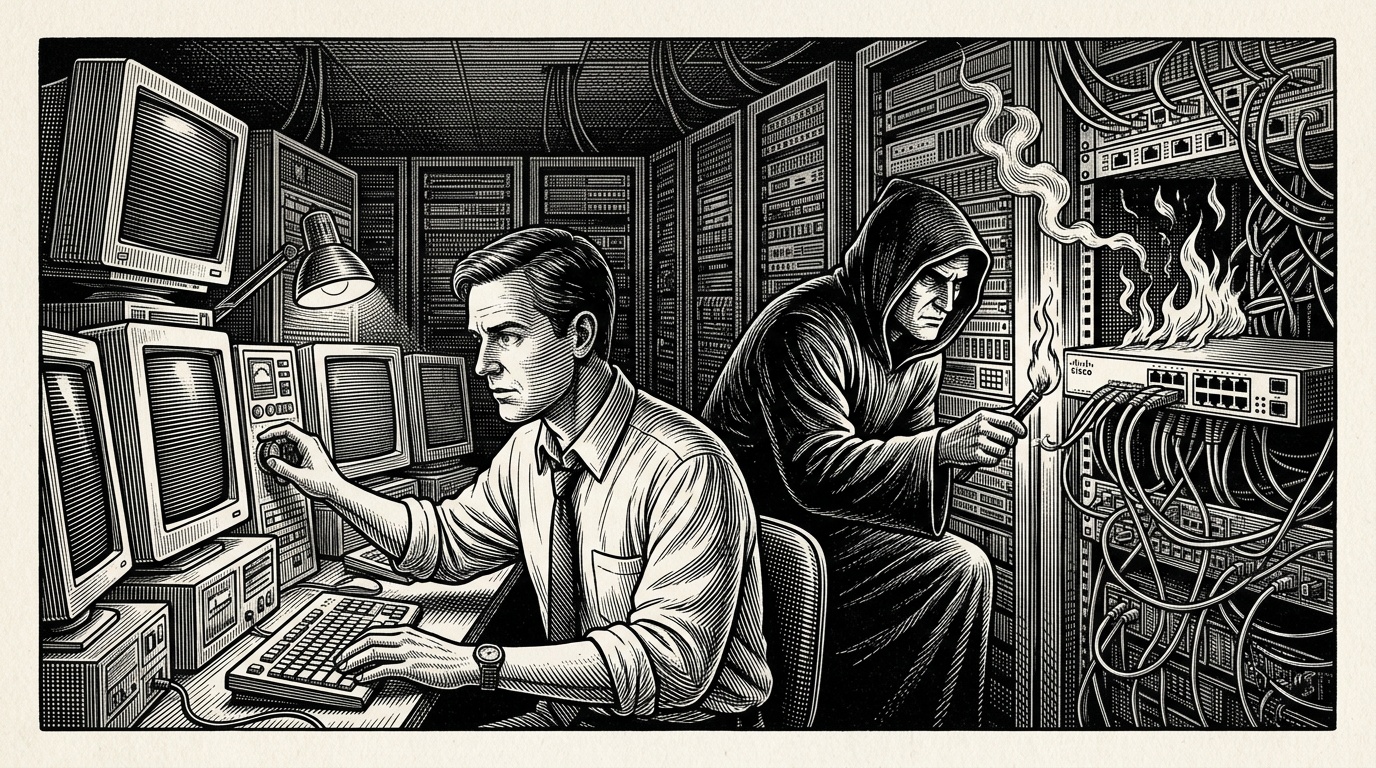
US and UK cybersecurity authorities have jointly disclosed the discovery of a previously unknown backdoor malware dubbed 'Firestarter' on the network of an unnamed US federal agency, raising fresh alarms about the ongoing targeting of government infrastructure — particularly through vulnerable Cisco networking equipment.
The US Cybersecurity and Infrastructure Security Agency (CISA), working alongside its UK counterparts, has uncovered and neutralised a sophisticated backdoor malware on a US federal agency's network, the agencies announced on April 24. The malware, named Firestarter, had not been previously documented, suggesting a well-resourced threat actor with the capability to develop novel intrusion tools.
Neither CISA nor the UK agency involved — believed to be the National Cyber Security Centre (NCSC) — disclosed the name of the targeted federal body, a common practice when investigations are ongoing or further exposure risks remain.
The discovery represents the latest chapter in a prolonged campaign targeting Cisco networking hardware used across government and critical infrastructure environments. Cisco devices have been a persistent focus for state-sponsored and sophisticated criminal actors, owing to their widespread deployment in sensitive networks and a series of vulnerabilities that have emerged over recent years.
Firestarter appears to function as a persistent access mechanism — a backdoor allowing attackers to maintain covert presence on a network, potentially exfiltrating data or laying the groundwork for more disruptive operations. The malware's previously unknown nature suggests it may have evaded standard detection tools for an indeterminate period before being identified.
CISA's advisory serves as a broader warning to government agencies and critical infrastructure operators to audit their Cisco deployments and review network telemetry for indicators of compromise associated with the newly identified threat.
The joint US-UK disclosure underscores the increasingly collaborative nature of Western cybersecurity defence, with allied agencies pooling intelligence to identify and attribute threats that cross national boundaries. Such partnerships have become a cornerstone of the international response to state-sponsored cyber intrusions.
At the time of publication, no threat actor or nation-state has been publicly attributed responsibility for the Firestarter intrusion. Attribution in such cases typically follows weeks or months of forensic analysis, and agencies often decline to name suspected perpetrators until they are confident in the evidence.
Analysis
Why This Matters
- A successful backdoor implant on a federal agency network — even if subsequently removed — indicates attackers achieved persistent access, potentially for data collection or pre-positioning for future disruption.
- The joint US-UK advisory signals that allied governments view this threat as serious enough to warrant broad public warning, suggesting other agencies may be similarly at risk.
- As Cisco hardware remains ubiquitous across government and enterprise networks globally, the continued targeting of these devices represents a systemic vulnerability with wide-ranging implications.
Background
Cisco networking equipment has been the subject of sustained exploitation campaigns for several years. High-profile vulnerabilities — including flaws in IOS XE software disclosed in 2023 that saw tens of thousands of devices compromised — have made Cisco kit a prime target for sophisticated actors, including those linked to China, Russia, and Iran.
The US federal government has faced a series of significant cyber intrusions in recent years, including the 2020 SolarWinds supply chain attack that compromised dozens of agencies, and a 2023 Microsoft Exchange breach attributed to a Chinese state-sponsored group that accessed email accounts at multiple federal departments. Each incident has prompted calls for accelerated modernisation of federal IT infrastructure.
CISA has progressively expanded its operational role in federal network defence, moving from an advisory posture toward active monitoring and incident response under authorities granted by the 2021 Executive Order on Improving the Nation's Cybersecurity.
Key Perspectives
CISA and Government Defenders: The agencies frame the disclosure as a proactive warning, emphasising their capacity to detect and neutralise novel threats. The joint publication with UK counterparts signals confidence in the intelligence and a desire to harden allied networks before similar intrusions occur elsewhere.
Federal Agencies and Network Operators: IT and security teams across government face pressure to patch and audit Cisco deployments rapidly, often while managing legacy infrastructure with limited resources. The non-disclosure of the affected agency may frustrate peer agencies uncertain whether their own networks are clean.
Critics and Oversight Bodies: Congressional cybersecurity watchers are likely to press for more transparency about the scope and duration of the Firestarter intrusion, and whether classified data was accessed. Critics of current federal cyber posture argue that repeated compromises of the same class of infrastructure suggest systemic procurement and patching failures.
What to Watch
- Whether CISA publishes a full technical advisory with indicators of compromise (IoCs), which would allow private sector and international partners to scan their own networks.
- Any attribution announcement from the US intelligence community or Department of Justice identifying the responsible threat actor or nation-state.
- Congressional hearings or classified briefings that may surface additional details about the duration of access, data potentially exfiltrated, and the identity of the affected agency.