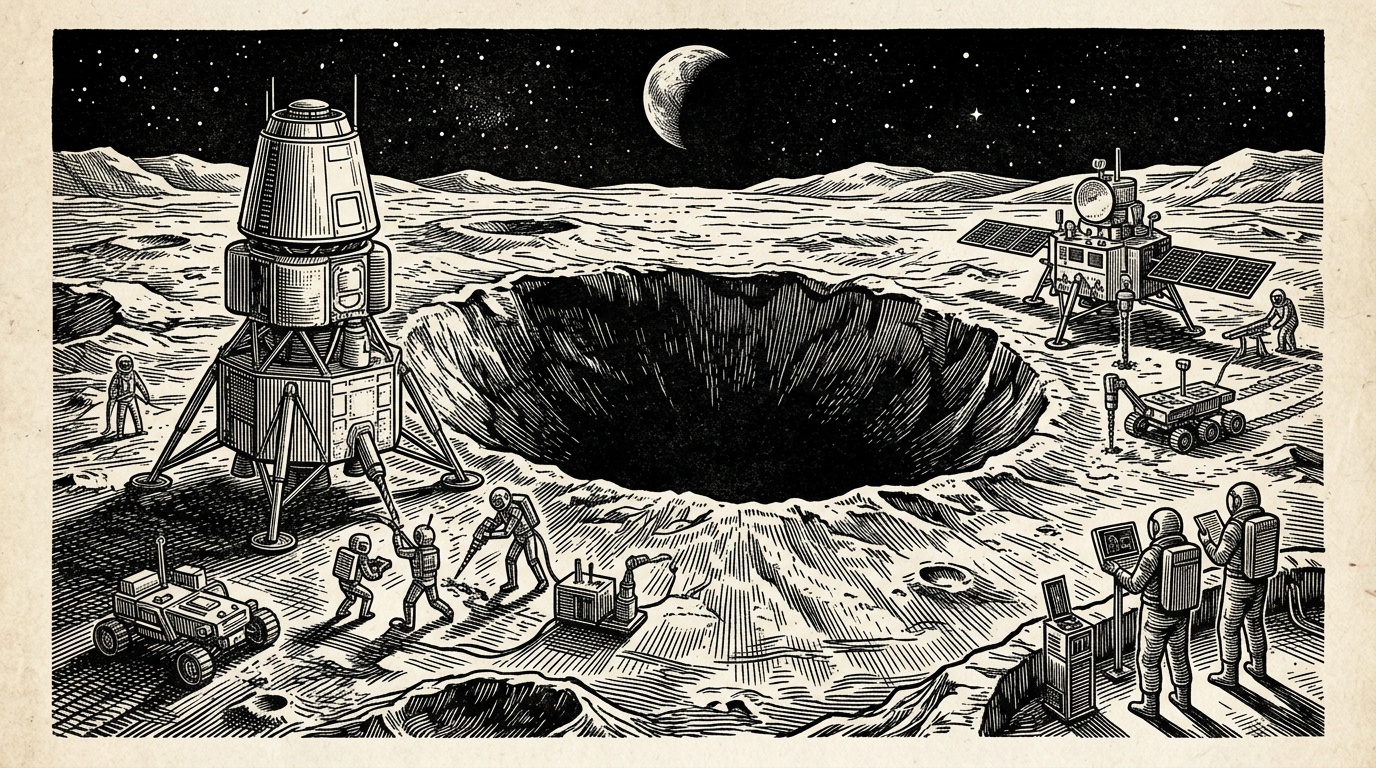
Two of the most ambitious robotic lunar missions ever attempted are preparing for launch later this year, as Blue Origin's Endurance spacecraft and China's Chang'e 7 mission independently race to land near Shackleton Crater — an ancient impact basin at the Moon's south pole believed to contain vast reserves of water ice.
The competition to reach one of the Moon's most scientifically and strategically significant sites is taking shape on two continents simultaneously. Blue Origin's Endurance lander departed NASA's Johnson Space Center in Houston over the weekend, travelling by barge to Cape Canaveral, Florida, where it will undergo final preparations before launching aboard the company's heavy-lift New Glenn rocket. Just two days prior, China's Chang'e 7 mission arrived at the Wenchang Space Launch Center on Hainan Island to begin integration with its Long March 5 rocket.
The Endurance lander will be the largest lunar lander ever built, surpassing even the Apollo lunar module that carried astronauts to the Moon between 1969 and 1972. Blue Origin, founded by Amazon billionaire Jeff Bezos, completed a comprehensive thermal testing campaign in Houston to verify the spacecraft can endure the extreme temperature swings on the airless lunar surface.
China's Chang'e 7 mission, while featuring a smaller lander, is arguably the more complex undertaking in terms of the number of components involved. The mission includes an orbiter, a surface rover, a lander, and — in a notable first — a small hopper drone designed to descend into permanently shadowed craters and directly scout for hidden ice deposits. These craters, which never receive sunlight, are considered the most likely locations where water ice has accumulated over billions of years.
Shackleton Crater, roughly 21 kilometres in diameter and located almost directly at the lunar south pole, is the focal point of both missions. Water ice found there would be of enormous value: it could be extracted and converted into drinking water, oxygen, and hydrogen-based rocket fuel, potentially serving as a refuelling depot for deeper space exploration missions to Mars and beyond.
The convergence of two well-resourced missions on the same target within the same launch window underscores how rapidly the geopolitical and commercial contest over lunar resources has intensified. NASA's Artemis programme has long identified the south pole as the destination for the first crewed lunar return, and has partnered with Blue Origin to develop the Endurance lander as part of that effort. China, meanwhile, has stated its own ambitions to land astronauts near the south pole before the end of the decade.
Neither mission has confirmed an exact launch date, though both are expected to lift off within the coming months. The journey to the Moon typically takes several days to weeks depending on the trajectory chosen, meaning the two spacecraft could potentially be operating in the same region simultaneously.
Analysis
Why This Matters
- Water ice at the lunar south pole is considered the most valuable resource in near-Earth space — whoever establishes a reliable presence there gains a significant strategic and economic advantage in future space operations.
- Both missions directly support longer-term crewed lunar programmes: Blue Origin's lander is tied to NASA's Artemis plans, while Chang'e 7 advances China's stated goal of landing astronauts on the Moon before 2030.
- The outcome could shape international norms and agreements around the exploitation of lunar resources, a legal grey area that remains unresolved under existing space law.
Background
Interest in the Moon's south pole accelerated sharply after NASA's LCROSS mission in 2009 confirmed the presence of water ice in permanently shadowed craters. India's Chandrayaan-3 mission made history in August 2023 as the first spacecraft to successfully land near the south pole, returning data that further validated the region's scientific importance.
The United States and China have both identified the south pole as the centrepiece of their respective crewed lunar return programmes. NASA's Artemis programme, originally targeting a crewed south pole landing as early as 2026, has faced repeated delays, pushing timelines back. China's lunar programme has advanced steadily, with the Chang'e series of missions building expertise in lunar orbit, landing, and sample return — most recently with Chang'e 6's far-side sample return in 2024.
Blue Origin's involvement deepened when NASA selected its Blue Moon lander architecture as a second Human Landing System provider in 2023, alongside SpaceX's Starship. The Endurance lander being tested now is a precursor and demonstration mission intended to build operational confidence ahead of crewed flights.
Key Perspectives
Blue Origin / NASA: The Endurance mission represents a critical step in validating commercial lunar landing capabilities and demonstrating that the south pole is accessible for long-duration operations. A successful landing would strengthen the case for the Artemis programme's architecture and timeline.
China's National Space Administration: Chang'e 7 is framed as a scientific mission to characterise the lunar south pole environment in detail, but it also advances China's broader goal of establishing a permanent robotic and eventually crewed presence there. The hopper drone is a technically novel element that could yield unique data on subsurface ice.
Critics and Observers: Some space policy analysts caution that framing the missions primarily as a "race" risks obscuring the genuine scientific value both missions offer, and could push decision-makers toward speed over safety. Others note that the absence of a binding international framework governing lunar resource rights creates potential for future conflict if both nations establish overlapping infrastructure near the same site.
What to Watch
- Confirmed launch windows for both New Glenn (carrying Endurance) and Long March 5 (carrying Chang'e 7), expected to be announced in the coming weeks.
- Whether either mission encounters technical delays — both are among the most complex robotic lunar landers ever attempted.
- Any diplomatic signals from the US or China regarding coordination, competition, or resource-sharing arrangements near the south pole, particularly through the Artemis Accords framework.