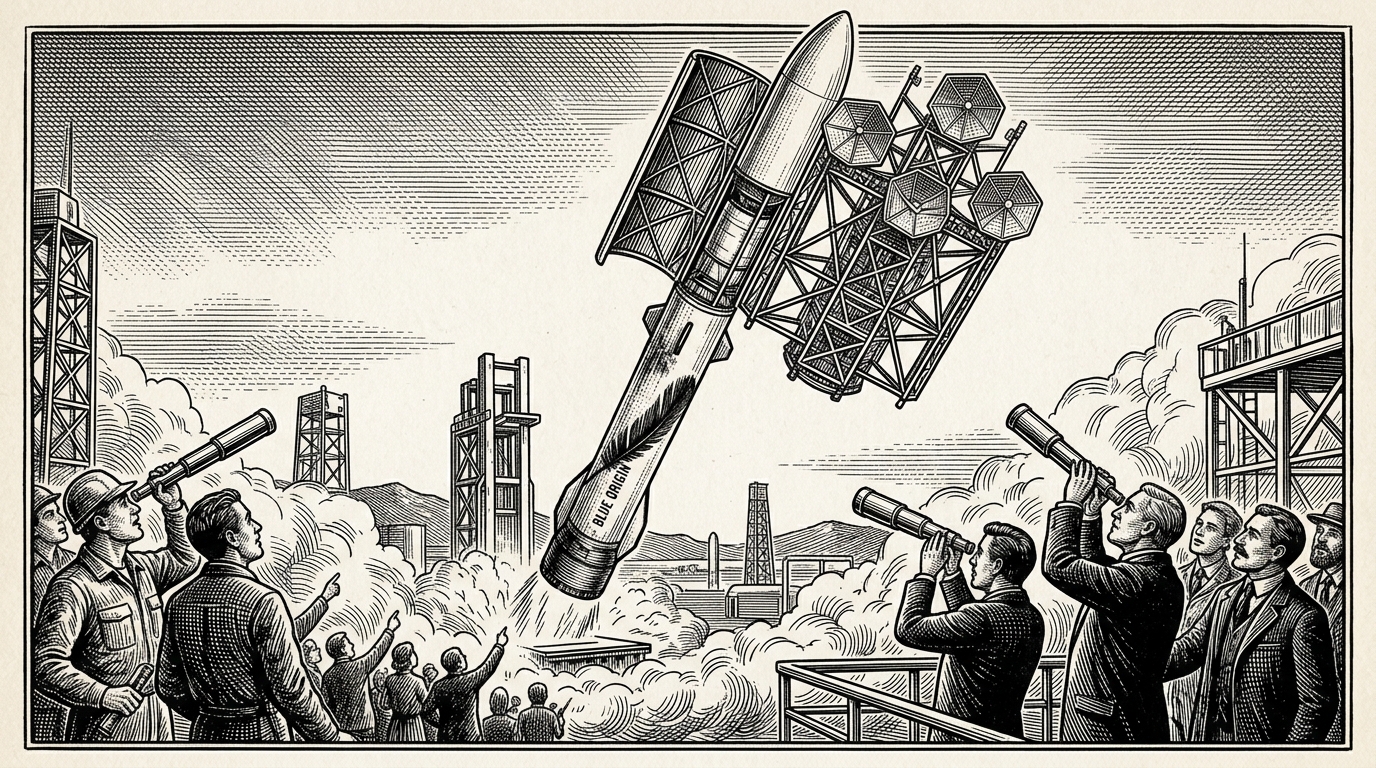
Blue Origin is set to launch its New Glenn rocket on Sunday, marking a pivotal moment in commercial spaceflight: the first reuse of a New Glenn first-stage booster, while simultaneously carrying AST SpaceMobile satellite hardware designed to eliminate mobile dead zones on Earth.
Jeff Bezos' Blue Origin is preparing for one of its most significant rocket launches to date this Sunday, sending a previously flown New Glenn booster back to orbit in a test that could reshape the commercial launch industry and accelerate the race to provide universal mobile coverage from space.
The mission is notable on two fronts. First, it will refly the first-stage booster that launched and landed successfully during New Glenn's second mission in November 2025 — a critical milestone that could challenge SpaceX's long-standing dominance in reusable orbital launch vehicles. Second, the payload includes hardware from AST SpaceMobile, a company building what it describes as a space-based cellular broadband network capable of connecting standard smartphones directly to satellites.
The Reusability Stakes
Booster reusability is widely regarded as the key to economically viable rocket launches. SpaceX's Falcon 9, which has flown individual boosters more than 20 times, has used this advantage to drive down launch costs and capture the majority of the commercial satellite market. A successful New Glenn booster reuse would signal that Blue Origin has cleared one of the most significant engineering and economic hurdles in the industry.
For Amazon, the commercial implications are especially pressing. The company's Project Kuiper — its planned low-Earth orbit broadband satellite constellation intended to compete with SpaceX's Starlink — requires a large number of launches to deploy at scale. Without a reusable rocket of its own, Amazon faces higher per-launch costs that could handicap Kuiper before it gains meaningful market share.
The Space Cell Tower
Beyond the booster test, Sunday's mission carries hardware from AST SpaceMobile, which is building satellites designed to function as cell towers in orbit. Unlike traditional satellite phones that require specialised handsets, AST's system aims to work with conventional smartphones by using large antenna arrays in space to compensate for the distances involved.
AST SpaceMobile is one of several companies — alongside SpaceX's Starlink direct-to-cell service and a growing number of competitors — racing to eliminate the dreaded "No Service" indicator that still plagues rural, remote, and developing-world users. Should this mission succeed, it would mark another step toward a world where mobile dead zones are a relic of the past.
A Three-Way Race Takes Shape
Analysts have noted that a successful mission this weekend could set up a genuine three-way competition in both the launch vehicle and satellite connectivity markets. SpaceX currently leads both segments with Falcon 9 and Starlink, but Blue Origin, Amazon, and AST SpaceMobile are positioning themselves to compete across multiple dimensions simultaneously.
Whether Sunday's launch proceeds on schedule will depend on weather and technical conditions at the launch site. Blue Origin has not publicly confirmed a backup launch window.
Analysis
Why This Matters
- A successful booster reuse by Blue Origin would end SpaceX's de facto monopoly on reusable orbital rockets, potentially driving down launch costs industry-wide and giving Amazon's Project Kuiper a viable path to rapid deployment.
- The AST SpaceMobile payload represents another step toward eliminating mobile dead zones globally — a development with significant implications for emergency services, rural connectivity, and billions of underserved users worldwide.
- If both objectives succeed in a single mission, it accelerates a broader restructuring of the satellite internet and launch industries, with consequences for consumers, investors, and geopolitics.
Background
SpaceX's Falcon 9 first demonstrated orbital-class booster reuse in 2017, and over the following years turned that capability into a decisive commercial advantage. By dramatically reducing per-launch costs, SpaceX cornered the market for both commercial payloads and government contracts, while rivals struggled to bring competing vehicles to flight.
Blue Origin, founded by Jeff Bezos in 2000, spent years focused on suborbital tourism with its New Shepard vehicle before developing the much larger New Glenn rocket. New Glenn made its debut launch in January 2025, and its second mission in November 2025 achieved the first successful booster landing — a breakthrough that set the stage for Sunday's reuse attempt.
Meanwhile, the satellite connectivity space has grown increasingly crowded. SpaceX's Starlink, which began service in 2020, now serves millions of customers worldwide. Its direct-to-cell feature, launched in partnership with T-Mobile, allows standard smartphones to send texts and eventually make calls via satellite. AST SpaceMobile, backed by major telecoms including AT&T and Vodafone, is pursuing a similar but distinct approach using very large satellite antennas.
Key Perspectives
Blue Origin / Amazon: A reused booster cuts costs and accelerates Project Kuiper deployment, giving Amazon a credible competitor to Starlink. Success also validates Blue Origin as a serious player in the orbital launch market after years of criticism over slow development timelines.
AST SpaceMobile: The company sees this mission as proof-of-concept for its direct-to-device satellite network. A functioning space-based cell tower could attract more telecom partnerships and investor confidence ahead of a full commercial rollout.
Critics / Skeptics: Some industry observers caution that a single successful reuse does not close the gap with SpaceX, which has refined its reusability processes over hundreds of flights. Others question whether the satellite connectivity market can support multiple large constellations economically, raising concerns about space debris and spectrum congestion as more operators crowd low-Earth orbit.
What to Watch
- Whether the New Glenn first-stage booster successfully lands following Sunday's launch, confirming repeatable reusability rather than a one-off result.
- AST SpaceMobile's timeline for commercial service activation following satellite deployment, and whether major telecom partners expand or extend their agreements.
- SpaceX's response — including any acceleration of Starlink direct-to-cell rollout or Falcon 9 pricing adjustments — as competition in both markets intensifies.