What they did
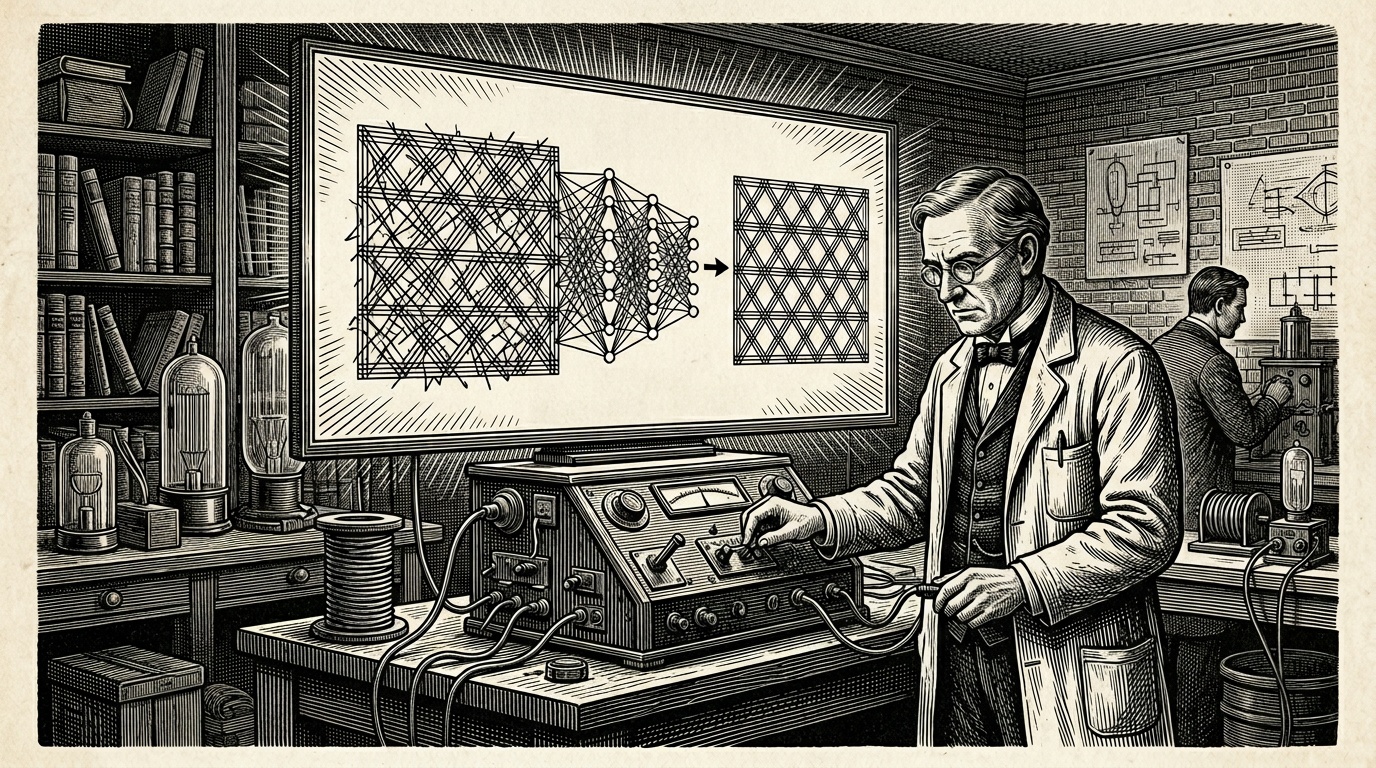
The authors designed a convolutional neural network (CNN) decoder whose architecture mirrors the geometric structure of quantum error-correcting codes: 3D convolutions for surface codes, and generalized toroidal convolutions for bivariate bicycle (BB) codes. The network processes spacetime syndrome data — the pattern of parity-check violations accumulated over multiple measurement rounds — and outputs per-logical-qubit error predictions along with calibrated confidence estimates.
They benchmarked the decoder primarily on the [144, 12, 12] bivariate bicycle (Gross) code under circuit-level noise, comparing against belief propagation plus ordered statistics decoding (BP+OSD), Relay, Tesseract, and a prior ML decoder. They evaluated both accuracy (logical error rate per qubit per cycle) and latency (amortized inference time on NVIDIA H200 GPUs), and explored a "Cascade" architecture that trades latency for accuracy.
Key findings
- On the [144, 12, 12] Gross code, the neural decoder achieves logical error rates up to ~17× lower than the best existing decoders, reaching ~10⁻¹⁰ at a physical error rate of 0.1%.
- The decoder reveals a "waterfall" regime where logical error rate scales as
p^{10.8} at moderate physical error rates, far steeper than the p^{5.4} scaling of BP+OSD, before transitioning to a distance-limited floor (p^{6.4}) at very low noise. This waterfall behavior, well-known in classical coding theory, had not been observed in quantum LDPC codes before. - Throughput is 3–5 orders of magnitude higher than prior decoders, with amortized latencies falling within the real-time budgets of superconducting, neutral-atom, and trapped-ion platforms.
- The decoder produces well-calibrated confidence scores, enabling significant reduction in time overhead for repeat-until-success fault-tolerant protocols (e.g., magic state distillation).
Why it matters
Current resource estimates for fault-tolerant quantum computation assume relatively modest error suppression scaling with code distance, leading to projections of millions of physical qubits for useful algorithms. The waterfall regime exposed by this decoder suggests that high-rate quantum LDPC codes can suppress errors far more aggressively than previously modeled — potentially with modest code sizes already compatible with near-term hardware. If these results hold up under realistic hardware noise, they imply that the space-time overhead of fault-tolerant quantum computing could be substantially lower than current estimates suggest, narrowing the gap between today's devices and practical quantum advantage.
Caveats
The results are based on standard circuit-level depolarizing noise models; real hardware exhibits correlated, biased, and non-stationary noise that may erode the waterfall advantage. The neural decoder requires GPU inference (NVIDIA H200), and while amortized latencies are promising, the integration of GPU-based decoding into real-time quantum control loops is an engineering challenge not yet demonstrated. Training costs and generalization to larger or different code families are not fully characterized. The confidence calibration, while useful, depends on the noise model matching reality.