What they did
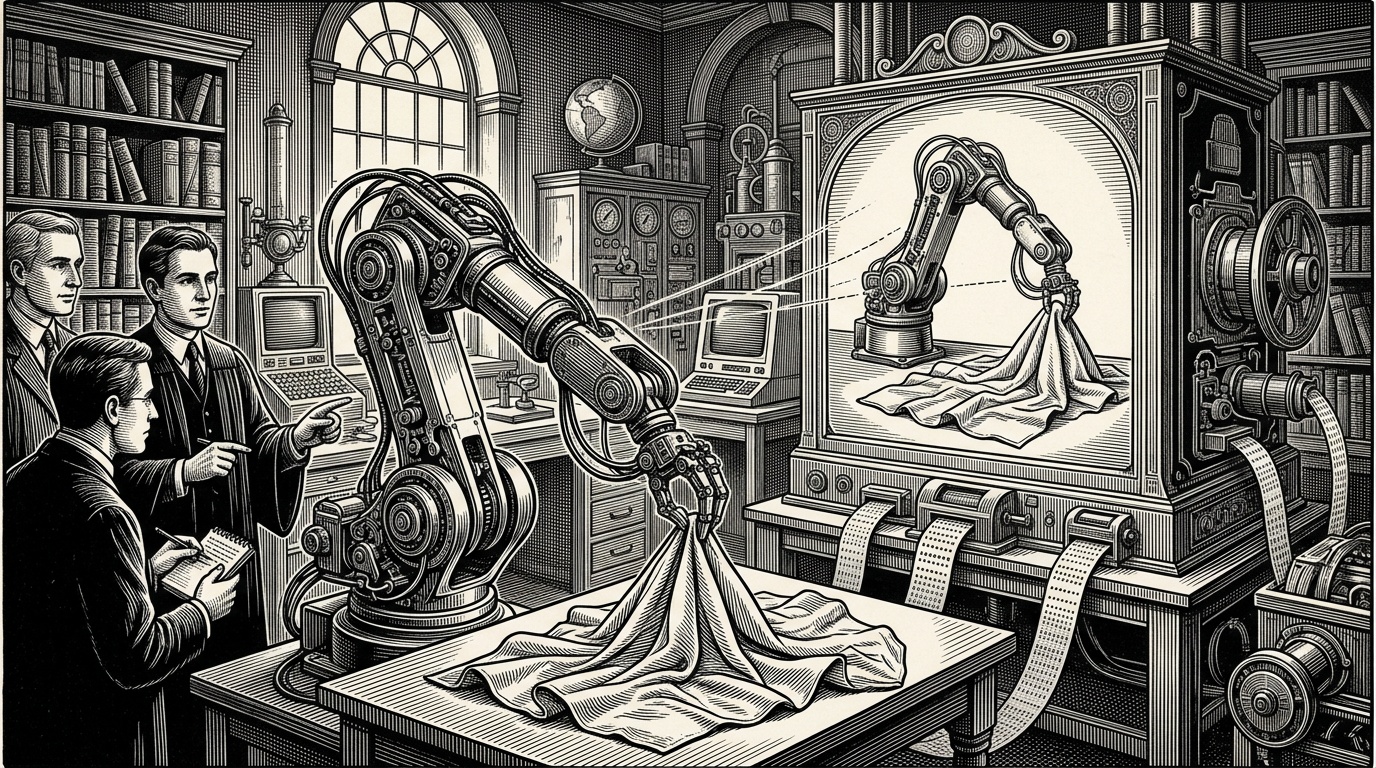
The authors built a three-stage pipeline. First, real scenes are reconstructed into simulation as metric-consistent digital twins. Second, deformable dynamics (e.g., cloth stiffness, elasticity) are calibrated against physical measurements rather than left at default simulator values. Third, a diffusion model generates new manipulation trajectories from the calibrated scene, and a quality filter removes physically implausible samples before the data is used for policy training.
Experiments targeted cloth manipulation tasks in real-world settings. Policies were trained on purely synthetic data produced by SIM1 and evaluated zero-shot on physical hardware, then compared against baselines trained on equivalent quantities of real demonstrations.
Key findings
- Policies trained on SIM1 synthetic data achieve 90% zero-shot success on real-world cloth manipulation tasks.
- Synthetic data provides a 1:15 equivalence ratio relative to real demonstrations — fifteen synthetic examples are needed to match one real demonstration in policy quality.
- SIM1-trained policies show 50% generalization gains over real-data baselines when evaluated on out-of-distribution configurations.
- The pipeline is described as operating from limited demonstrations, suggesting low entry cost for new task setups.
Why it matters
Deformable object manipulation is among the hardest regimes for sim-to-real transfer because shape, contact, and topology change continuously and are poorly captured by rigid-body simulators. SIM1 demonstrates that physics calibration — rather than purely increasing simulation fidelity through rendering — is the key bottleneck. If the 1:15 ratio holds across tasks, synthetic data generation could substantially reduce real-world data collection effort for cloth-class manipulation.
Caveats
The 1:15 equivalence ratio means synthetic data is not a free substitute; real demonstrations are still more informationally dense. Results are reported on cloth manipulation specifically, and it is unclear how the pipeline transfers to other deformable categories (granular materials, liquids, ropes). The diffusion-based trajectory generator and quality filter introduce their own failure modes that are not fully characterized. Independent replication and ablation of each pipeline stage would strengthen the claims.