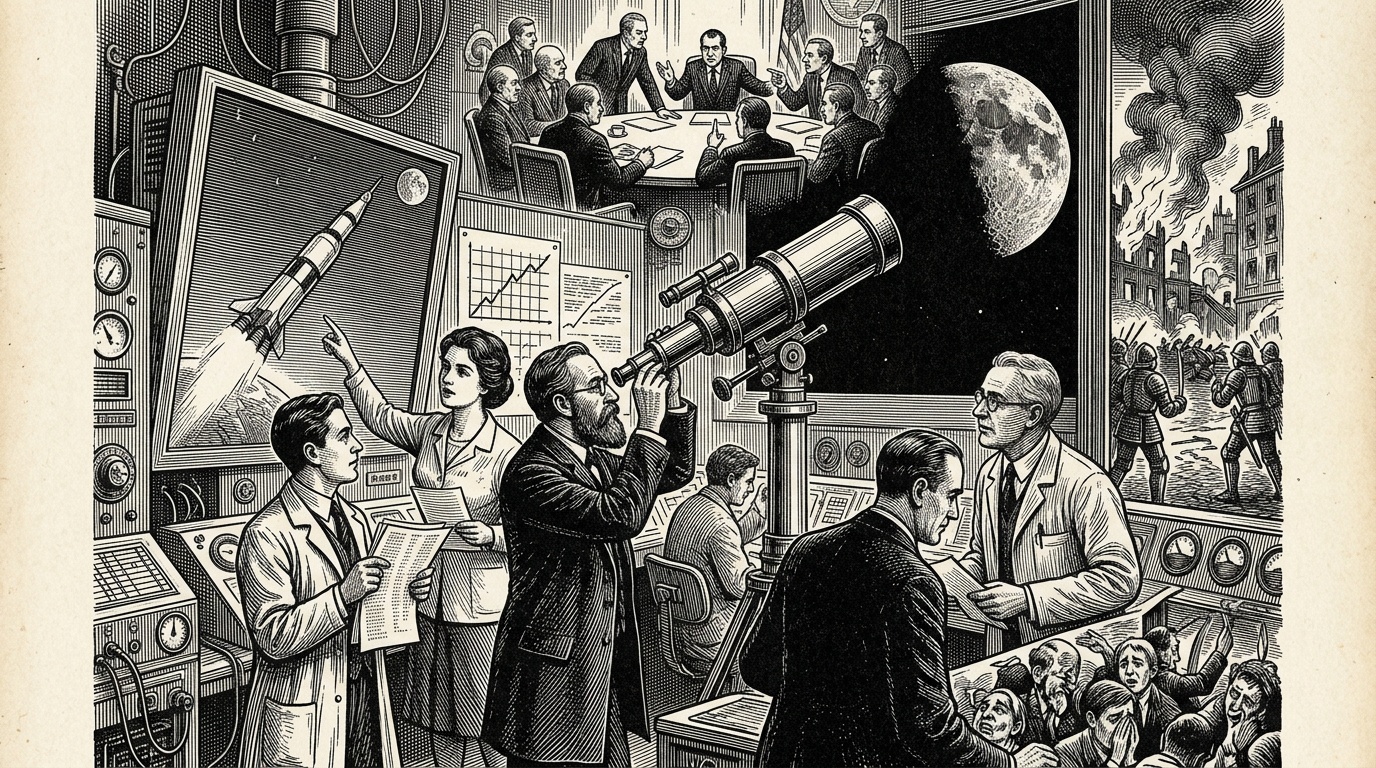
Fifty-eight years after Apollo 8's historic Christmas Eve orbit of the Moon, humanity has returned to lunar exploration in 2026, marking a new chapter in space exploration that parallels the original moonshot's role as a beacon of hope during turbulent times.
The parallels between 1968 and 2026 are striking. In both years, the world grappled with significant conflicts and social upheaval, making lunar missions a welcome source of inspiration and unity. The Apollo 8 crew's famous "Earthrise" photograph and Christmas Eve reading from Genesis provided a moment of transcendence during the Vietnam War era, while today's return to the Moon offers similar respite from contemporary global tensions.
However, the motivations and capabilities driving the 2026 lunar mission differ substantially from the Cold War-era space race. Where Apollo was primarily a geopolitical statement of American technological supremacy, today's lunar exploration represents a more collaborative and commercially-driven endeavor, with multiple nations and private companies participating in what has become known as the "New Space" economy.
Modern lunar missions focus on sustainable presence rather than symbolic achievement. Advanced life support systems, in-situ resource utilization, and permanent habitat construction represent technological leaps that make long-term lunar settlement feasible. The Moon now serves as a stepping stone for deeper space exploration, particularly Mars missions, rather than an end destination.
The scientific and economic benefits have also evolved. Today's missions prioritize lunar mining for rare earth elements, establishment of research facilities, and development of space-based solar power systems. These practical applications contrast with Apollo's primarily exploratory and symbolic objectives.
Commercial space companies play a central role in current lunar efforts, bringing cost efficiencies and innovation that government programs of the 1960s couldn't achieve. This public-private partnership model has democratized space access and created new economic opportunities.
While the fundamental human drive to explore remains unchanged, the 2026 return to the Moon represents humanity's maturation as a spacefaring species, moving from symbolic gestures to practical expansion beyond Earth.
Analysis
Why This Matters
- The return to lunar exploration signals a shift from symbolic space missions to practical, sustained human presence beyond Earth
- Commercial involvement in space exploration is creating new economic sectors and reducing costs for future missions
- Lunar missions serve as proving grounds for technologies needed for Mars exploration and deep space travel
Background
The original Apollo program (1961-1975) was born from Cold War competition, culminating in six successful Moon landings between 1969-1972. After Apollo 17, human lunar exploration ceased for over 50 years as priorities shifted to low Earth orbit activities like the Space Shuttle and International Space Station. The current return began with NASA's Artemis program, launched in 2017, which aimed to establish sustainable lunar presence by the mid-2020s. Unlike Apollo's government-only approach, modern lunar missions involve international partnerships and commercial companies like SpaceX, Blue Origin, and others, fundamentally changing how space exploration is conducted and funded.
The intervening decades saw dramatic advances in robotics, materials science, life support systems, and computing power that make permanent lunar habitation feasible. The discovery of water ice at the lunar poles and improved understanding of lunar resources have transformed the Moon from a distant target to a potential second home for humanity.
Key Perspectives
Space Agencies: View lunar return as essential stepping stone for Mars exploration and deep space missions, emphasizing scientific research and technological development for sustainable space presence.
Commercial Space Companies: See lunar missions as business opportunities for mining, tourism, and manufacturing in low gravity environments, driving innovation through profit motives.
Critics/Skeptics: Question massive spending on space exploration while Earth faces climate change, poverty, and other pressing issues, arguing resources should address terrestrial problems first.
What to Watch
- Success of permanent lunar base establishment and resource extraction operations
- Development of lunar economy and commercial viability of space-based industries
- Progress toward using lunar missions as launch platforms for Mars exploration missions planned for the early 2030s