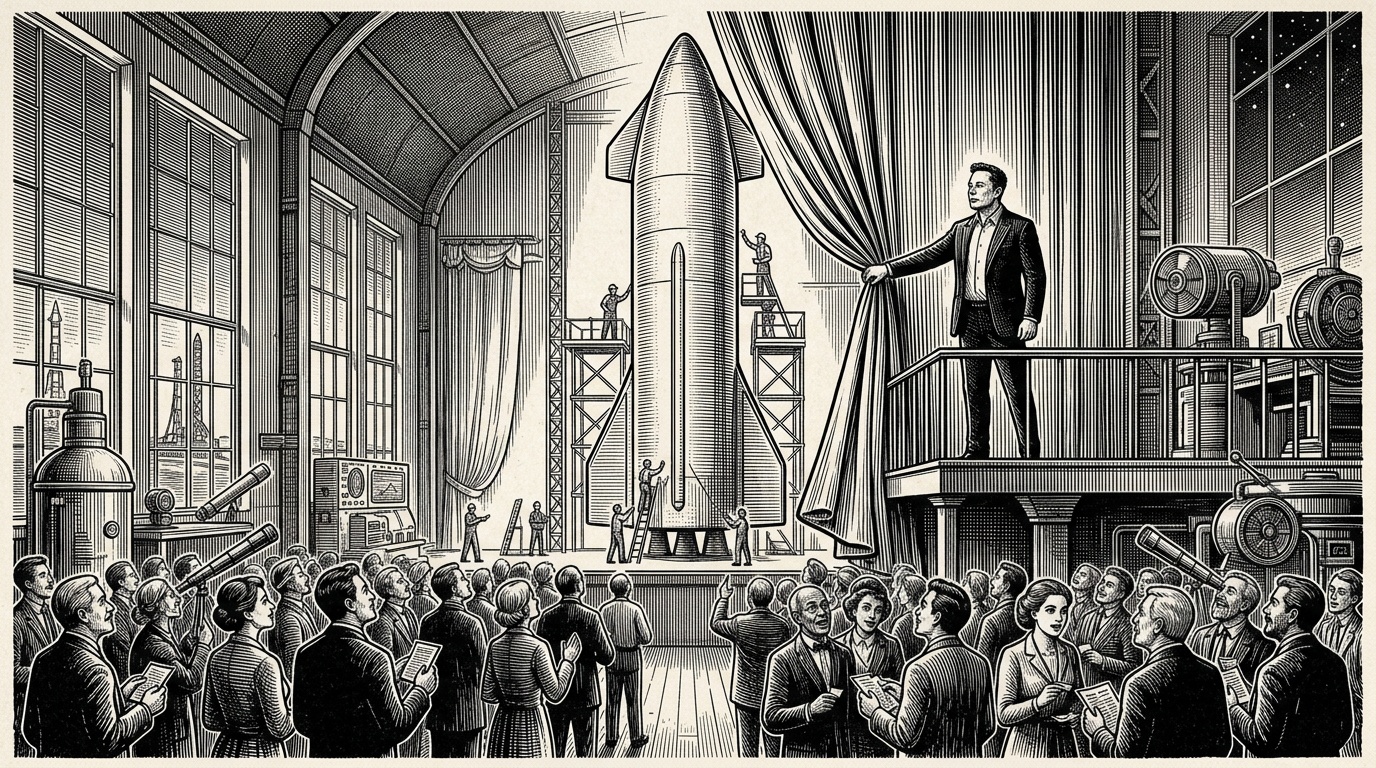
SpaceX, the rocket and satellite company founded by Elon Musk, is moving closer to a public market listing that some analysts value at over $1 trillion, a figure that would make it one of the most valuable companies ever to debut on a stock exchange and that has divided financial observers between those who see a generational investment opportunity and those who warn of speculative excess.
SpaceX Weighs Historic Public Offering
SpaceX, the privately held aerospace company that has reshaped the global launch industry over the past two decades, is reportedly advancing plans for an initial public offering (IPO) that would allow retail investors to buy shares in the company for the first time.
Valuations circulating in financial markets place the company north of $1 trillion, according to Reuters, a figure that would put it in rare company alongside Apple, Microsoft, and Nvidia as one of a handful of American corporations to reach that threshold.
A Company Like No Other
SpaceX operates across several distinct and high-value business lines: its Falcon 9 rocket remains the world's most frequently launched orbital vehicle, its Starship system is under active development as the most powerful rocket ever built, and its Starlink satellite internet constellation now serves millions of subscribers globally.
The breadth of the business is one reason some analysts argue the trillion-dollar figure is defensible. Starlink alone generates recurring subscription revenue, while the launch business benefits from long-term government contracts — including a substantial relationship with NASA — and a growing commercial manifest.
The Bull and Bear Cases
Proponents of a SpaceX investment point to the company's demonstrated ability to disrupt and dominate markets that were once the exclusive province of government agencies and legacy defence contractors. The reusable rocket technology pioneered by SpaceX has driven launch costs down dramatically, and Starship, if it reaches full operational capability, could further compress the economics of getting mass to orbit.
Sceptics, however, raise concerns about the company's governance structure and its close ties to Musk, whose simultaneous leadership of Tesla, xAI, and his role in the Trump administration's Department of Government Efficiency have attracted scrutiny. They also question whether even a thriving space economy can justify a valuation that exceeds some of the world's largest and most profitable corporations.
There is also the question of execution risk. Starship remains in active testing, and the ambitious timelines Musk has publicly outlined — including crewed missions to Mars — carry enormous technical and financial uncertainty.
The Broader Space Economy
The IPO debate arrives at a moment when the commercial space sector is expanding rapidly, with satellite communications, Earth observation, and launch services all drawing significant private capital. Yet the sector has also seen high-profile failures, and investors who backed early-stage space ventures have not always been rewarded.
SpaceX's scale and track record set it apart from most competitors, but as The Verge notes, whether that translates into durable shareholder returns at a trillion-dollar entry point is the central question retail investors will need to weigh carefully.
No formal IPO filing has been confirmed, and the timing of any public offering remains unclear.
Analysis
Why This Matters
- A SpaceX IPO at a trillion-dollar valuation would be one of the largest public market debuts in history, opening a previously inaccessible asset class — commercial space infrastructure — to everyday investors.
- The offering would test whether the retail investment enthusiasm that has driven meme stocks and crypto also extends to capital-intensive, long-horizon aerospace bets.
- The outcome could reshape how private space ventures attract and structure capital for years to come, influencing competitors and sovereign space programs alike.
Background
SpaceX was founded by Elon Musk in 2002 with the stated goal of making humanity a multi-planetary species. For most of its existence it has remained private, funded through a combination of NASA contracts, commercial launch revenues, and periodic private funding rounds that have steadily ratcheted up its implied valuation.
The company's breakthrough came with the development of the reusable Falcon 9 rocket, which first successfully landed and reflew a booster in 2015-2016, fundamentally altering the economics of the launch industry. Since then, SpaceX has captured a dominant share of both government and commercial launch contracts globally.
Starlink, its satellite internet subsidiary, began service in 2020 and has grown rapidly, providing connectivity in underserved regions and, notably, in active conflict zones including Ukraine. The constellation now comprises thousands of satellites and is considered one of SpaceX's most commercially mature and scalable assets.
Key Perspectives
Bullish Investors: Argue SpaceX's combination of launch dominance, Starlink's subscription revenue, and first-mover advantage in next-generation space infrastructure justifies a premium valuation. They point to the company's record of actually delivering on technically audacious goals.
Sceptical Analysts: Warn that a trillion-dollar valuation prices in outcomes — including Mars colonisation and full Starship operability — that remain speculative. They note that even highly profitable tech companies trade at lower revenue multiples than SpaceX's implied pricing suggests.
Critics/Skeptics: Raise governance concerns centred on Musk's divided attention and the concentration of decision-making power. Some also flag regulatory and geopolitical risk, including the company's dependence on US government contracts and the potential for political exposure given Musk's role in the Trump administration.
What to Watch
- Any formal S-1 registration statement filed with the US Securities and Exchange Commission, which would trigger mandatory financial disclosure and set a concrete IPO timeline.
- Starship's progress toward full operational status, including upcoming integrated flight tests, which would materially affect investor confidence in the company's long-term revenue thesis.
- Changes in Musk's political and corporate commitments that could alter the governance risk calculus for institutional investors whose mandates require stable leadership structures.